Nyalas' Lateral Display And Ground Horning Are Designed To Impress


Nyala Lateral Display Keeps Rivals At Bay

A friend recently gave me a superb book about African wildlife. I'm a late starter who has much to learn, so his choice - The Behavior Guide to African Mammals - could not have been more appropriate.

The book, by Richard Despard Estes, was conceived for the benefit of visitors to African parks. On that level it serves as an essential field guide to those with more than a passing interest in African animals, but it's also sufficiently detailed to serve as a reference for students and behavioral scientists.

When visiting African game parks, one often sees animals acting in strange or inexplicable ways. It's easy to simply accept this as "animal behavior" - something we're not expected to understand. But a book like this makes game viewing much more rewarding and less of a mystery. Instead of thinking "mmm, odd behavior" and moving on, one can better understand what's happening now, possibly what happened before, and what's likely to happen next.

Dominance/Threat Displays

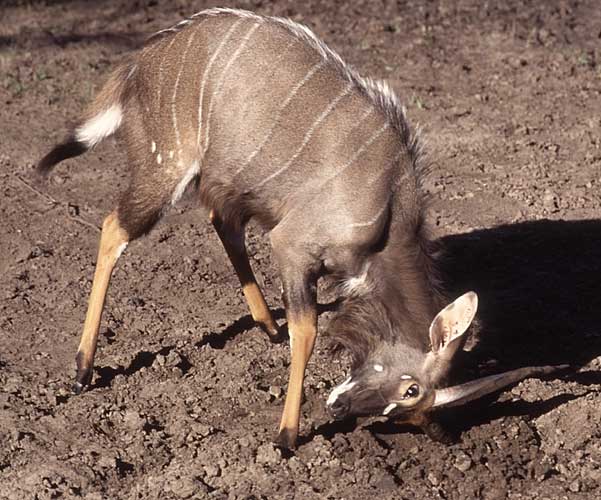
While skimming through the book, a sketch caught my eye - it shows a Nyala bull, head sideways, rubbing one horn on the ground. I'd seen this before - at Ndumo Game Reserve in northern KwaZulu-Natal - and at the time assumed the animal was rubbing its horn to relieve some sort of irritation.

But no, it's actually one of the nyala's dominance/threat displays, that include "lateral presentation, stiff-legged approach and ground- and object-horning".

Picture of nyala bull ground horning
Nyala "ground-horning", Ndumo Game Reserve
Click on any picture to enlarge
Picture will open in a new window
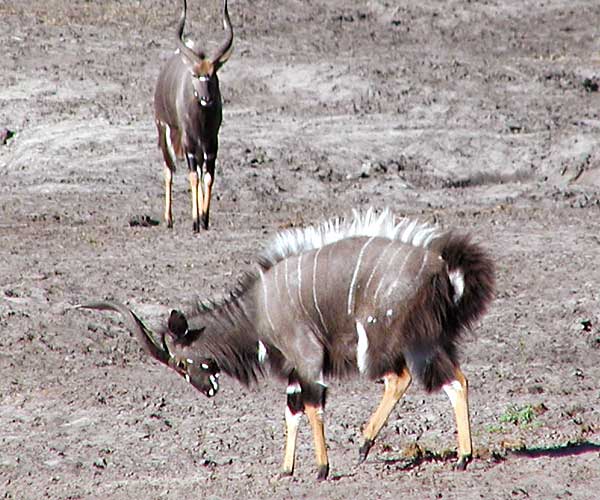
If you're ever in nyala territory, even if you don't see all of the above behavior, you're quite likely to see the nyala's spectacular lateral display when there are a number of males around.

During this display, the nyala's hair fringe and dorsal crest "can increase its apparent surface area by up to 40%".

Photo of nyala in lateral display
Nyala bull's "lateral display" on approach of another bull
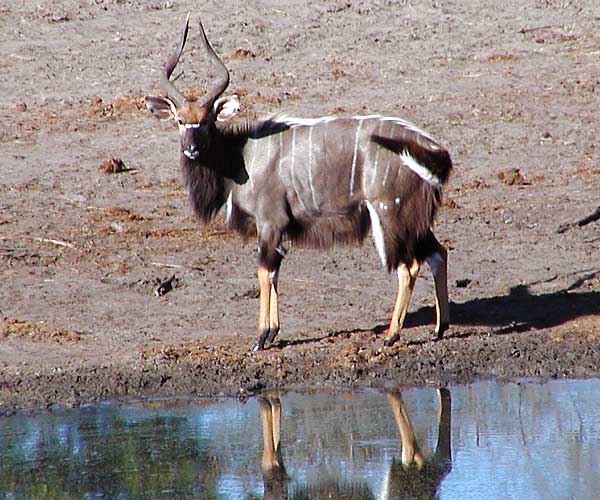
Photo of Nyala bull
Nyala bull - normal appearance
According to the author, the displays vary in intensity and at highest intensity, "movement stops except to maintain the broadside orientation, and the tail is draped over the bull's rump, fully fluffed, so that the maximum area of white is displayed towards the opponent. Males that perform this all-out display always win".

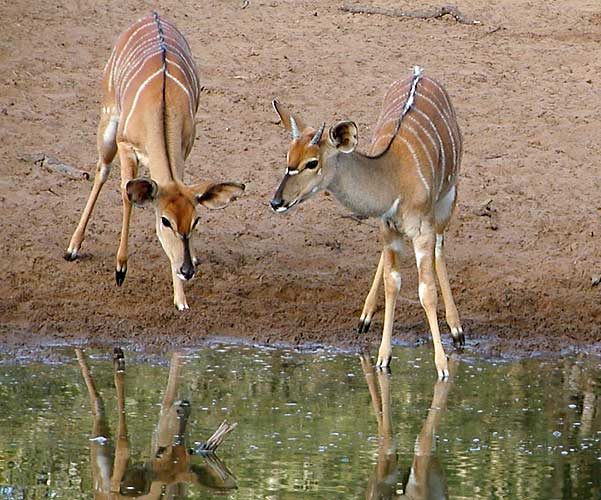
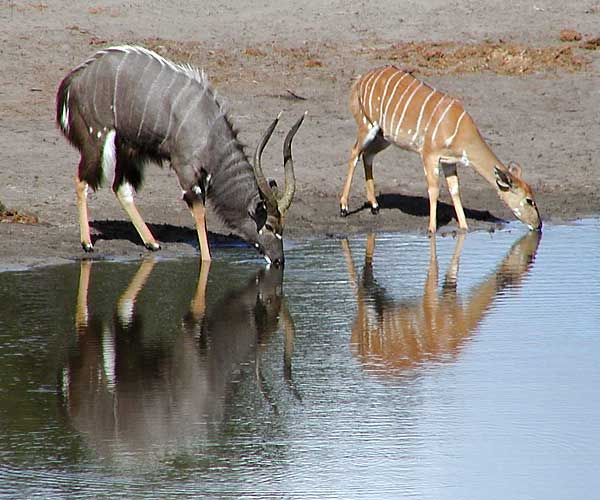
Nyala are also interesting in that adult bulls, in addition to carrying the superb lyre-shaped horns, are markedly different from females and juveniles in size, color, and overall appearance.

While females and young have a smooth coat that is bright chestnut with distinct stripes and spots, males have a shaggier coat that's more charcoal to slate in color with side stripes that are less contrasty.

The pictures below, of a female and young male, and an adult bull next to a female, illustrate this. Very different, yet exceptionally good-looking animals.

Picture of nyala female and young male Photo of nyala male and female together

All Wildlife Articles:

Africa's Most Dangerous - "What If?"

Lion Facts and Information

Spotted Hyena - the Hermaphrodite Myth

Male Waterbuck - Ruggedly Handsome Antelope

Nile Crocodile - Stranger than Fiction

Monitor Lizards - Fearsome Predators

Safari Night Drives - the Red-Light Experience

Fish Eagle - Icon of the African Bush

Wild Dogs - Efficient Hunters that Kill to Eat

Wild Dog Society - All About Co-Operation

The Hippo's Reputation is not Deserved

Weaver Birds Brighten up our Lives

How the Warthog got its Name

Python Nabs Vervet Monkey

Black Mamba and other Snake Myths

Lions Mating

Swimming Lion Tackles Zambezi

African Elephant Biofile

Elephant Communication

Elephant Reflections is a "Must-Read" Book

Baboon Refuses to Abandon Dead Baby

Cheetah & Hyena Confrontation

Mongoose Survives Encounter with Lions

Hippo Keeps Crocs at Bay

How Giraffes Sort Leaves from Thorns

Go on Virtual Safari with WildCam Africa

Rhino Capture and Relocation

Nyala Dominance Displays

Life Behind Bars for Pet Monkeys

I Support WWF

Home /  Gallery /  Stock Pics /  Wildlife Shop /  Downloads /  Wildlife Info /  Photo Info /  Safari Info /  Wildlife Art /  Blog /  About /  Contact

Contact Details: Scotch Macaskill Cottage at 46 Moss Place, Montrose, Pietermaritzburg 3201, South Africa. Tel: +27 (0)33 347 0905. Privacy: Your privacy is guaranteed. See our Privacy Policy for more. This site accepts advertising and other forms of compensation - see Disclosure and Advertising for details. Site updated: September 2010. Copyright © 2002 - 2010 Scotch Macaskill
