Contact Details: Scotch Macaskill, Dirt Road Traders, Currys Post Road, Howick, KwaZulu-Natal, South Africa. Tel: +27 (0)82 578 2329. Privacy: Your privacy is guaranteed. See our Privacy Policy for more. This site accepts advertising and other forms of compensation - see Disclosure and Advertising for details. Site updated: 2022. Copyright © 2002 - 2022 Scotch Macaskill

| ||||||||||
|
||||||||||
|
SEE ALL
|
Rhino Capture and Relocationby Scotch MacaskillThe recovery of the white rhino from near extinction 100 years ago is one of the great success stories of African wildlife conservation. By the start of the 20th Century, the uncontrolled killing of white rhinos had reduced the population to only 20 animals, located in the Umfolozi Game Reserve in KwaZulu-Natal province. This small group thrived under the protection of the Natal Parks Board (now known as Ezemvelo-KZN Wildlife), the South African conservation body that would earn worldwide recognition for developing rhino capture and relocation techniques. Following the success of its early initiatives in rhino conservation, the Board launched an ambitious project dubbed "Operation Rhino" in 1961 to ensure survival of the white rhino, of which there were only 437 left in the wild. Operation Rhino involved the relocation of white rhino breeding groups from their "home-base", the Hluhluwe and Umfolozi game reserves in KwaZulu-Natal, to other protected areas. By the end of 1999, a total of 2,367 white rhinos had been redistributed worldwide, of which 1,262 had been rehabilitated in Southern African protected areas. Early Methods of Capturing RhinoEarly rhino capture techniques pioneered by Dr Ian Player and Dr Tony Hawthorn involved darting large doses of immobilizing drugs into the animals.These animals were then followed with vehicles and horses before roping and manhandling them to the ground. This was cumbersome - and highly dangerous - as a rhino could take up to 20 minutes to go down from drugs, travelling several kilometres in the process. 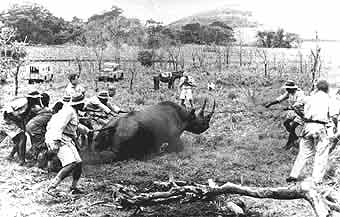
Then, in 1963, there was an important breakthrough with the advent of a new drug - M99 - a powerful morphine derivative. This drug took effect rapidly and could be administered in small doses, so eliminating the problem of dart wounds caused by the large volumes of drugs previously required. Once sedated with M99, a rhino will sink to the ground, allowing the capture team to rope the animal and take blood and other samples. Tiny microchips are drilled into both horns for identification should they ever enter the black market and be offered for sale Antidote AdministeredAn antidote to M99 is then administered. Once the dazed animal gets back to its feet, it can be led to a waiting capture crate. Bear in mind though that a dangerous, three-ton animal has now been revived - it takes great skill, expertise and courage to successfully load the rhino.There was a further breakthrough in the early 70s when helicopters were introduced. Now rhino could be located from the air and darted from the chopper with minimal stress. 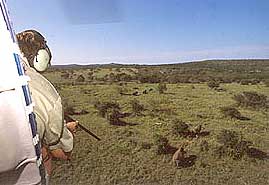
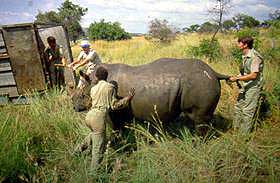 Not only is the rhino darted from the air, but the helicopter can guide the animal to accessible terrain, while also directing the ground crew to the correct area, where the animal can be loaded into the capture crate. Airlifting by HelicopterIn 1992 another step was taken to facilitate capture operations when helicopters were used to airlift rhino from the Umfolozi Wilderness area for the first time.Management policy prohibits the use of vehicles in this wilderness zone, which meant conventional capture methods were not possible. After a rhino is darted in the usual way from a small helicopter, a powerful helicopter capable of lifting in excess of 3 tons is directed to the spot where the animal is lying. A net is dropped and the ground crew then position the rhino on this, before the helicopter returns to hoist it up with ropes and slings, airlifting it directly to the recovery vehicles. With modern technology, rhino mortalities during moving operations and while in the holding pens or "bomas" have declined to less than one per cent. See also:
Return to Wildlife Info |
|||||||||
|
|
||||||||||