Scotch Macaskill's Wildlife Blog
IMPORTANT: Please note that from April 2009 this Blog's Web address changed as a result of a switch in the blogging platform we use. It's still an integral part of the Wildlife Pictures Online website and, we hope, will continue providing entertaining and enjoyable content in the form of wildlife images, news, views and information.
For the most recent posts, links, and other resources, please visit the new Wldlife Photography Blog.
|
Today's Picture: Banded Mongoose with abnormal markings
June 3, 2007
|
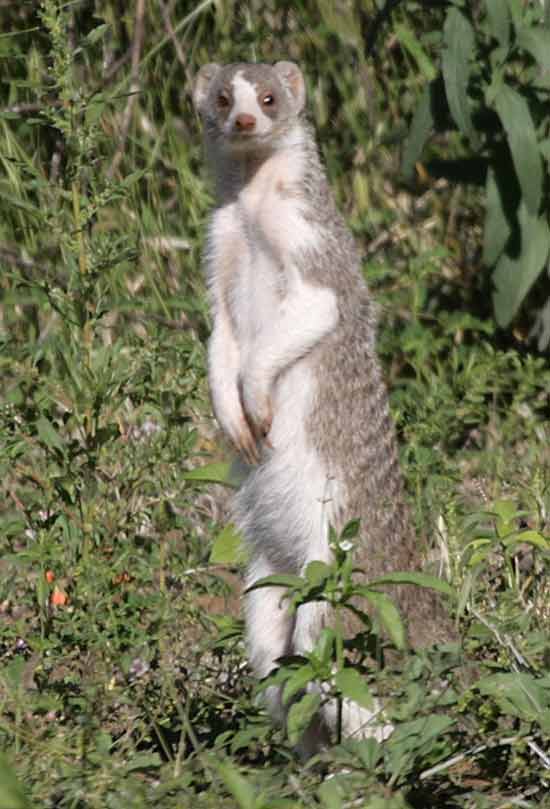
Photo Details: Banded mongoose (Mungos mungo) standing on its hindlegs, showing abnormal pure white markings on its limbs, face and underparts, Mashatu Game Reserve, Tuli Block, Botswana.
Camera: Canon EOS 400D; Lens: Canon 100-400 IS Zoom; Focal Length: 400mm; Shutter speed: 1/2000; Aperture: f5.6; ISO: 400.
Additional Info: The banded mongoose is usually an overall gray color with distinct dark bands running across its back, darker lower limbs and tail tip, and lighter underparts. The specimen above has the typical gray back with darker, transverse bands, but unusually it has pure white underparts and limbs, with some white marking extending along its face up to the forehead.
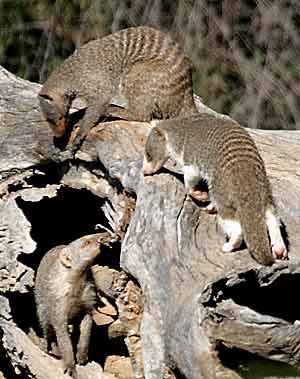
The mongoose was one of a small group, of which another had similar but less extensive white markings. The picture on the right shows two normal animals and the one with the heavy white markings as they forage about on an old tree stump. It's evident how much more conspicuous the partially white one is, making it an easier target for predators.
The color aberration is presumably caused by some form of genetic mutation. But I'm not a biologist so can't say whether the mongoose is a partial albino, where the white markings are the result of a lack of melanin, or whether they're caused by some other genetic abnormality.
In most pictures of albino animals, the entire coat is either white or near white, occasionally with some faint markings showing through. I was unable to find any pictures showing a piebald albino, where albinism evidently affects only certain areas of skin
I found this explanation of albinism on www.messybeast.com:
Albinism is due to one of several gene mutations that affect the production of normal pigmentation. There are varying degrees of albinism. True albino, or amelanistic, animals lack melanin and are white with no markings and with unpigmented pink eyes. In some species there is also a form known as blue-eyed (or "partial") albinism. There are also various degrees of patchy albinism - piebaldism - that occurs due to localised albino mutations in skin cells during embryo development. If the mutation occurs early in development, the patches are larger. If it occurs later, the patches are smaller.
|
Today's Picture: Crested Barbet
June 14, 2007
|
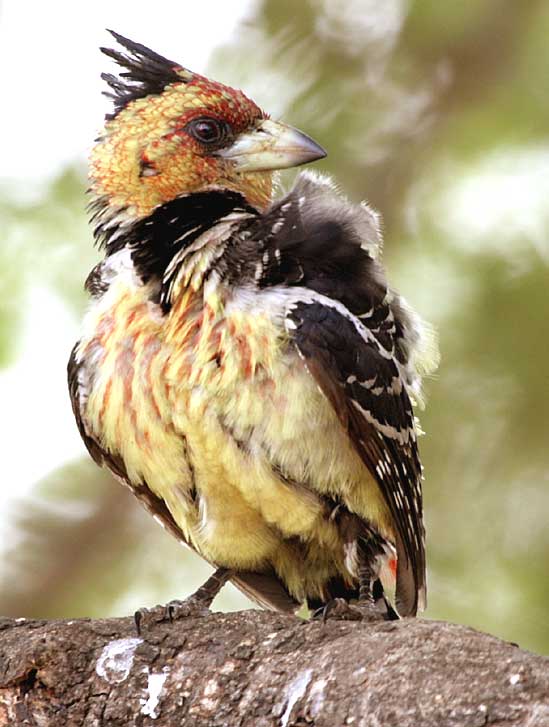
Photo Details: Crested barbet (Trachyphonus vaillantii) perched on a branch, Kruger National Park, South Africa.
Camera: Canon EOS 400D; Lens: Canon 100-400 IS Zoom; Focal Length: 400mm; Shutter speed: 1/100; Aperture: f5.6; ISO: 400.
Additional Info: The crested barbet is a colorful critter and looks a bit like an abstract painting with its yellow face and chest, randomly spattered with red, offset by a contrasting mix of black and white upper parts.
Crested barbets are common residents in southern Africa, found mainly in well-wooded regions, riverine forests and bushveld. They have adapted readily to urban gardens, particularly where fruit is available.
|
Today's Picture: Hippo Showing its Teeth in Yawning Display
June 18, 2007
|
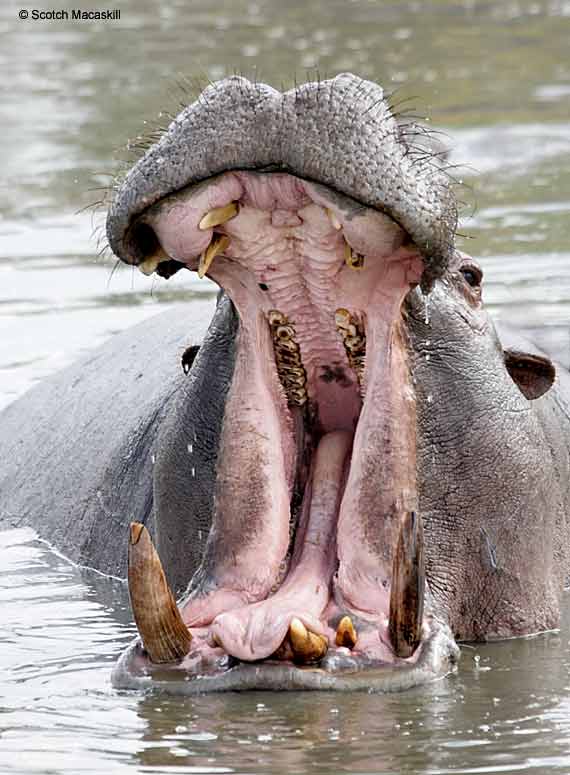
Photo Details: Hippopotamus (Hippopotamus amphibius) showing off its formidable teeth and jaws in a yawning display, Santawani area, Botswana.
Camera: Canon EOS 400D; Lens: Canon 100-400 IS Zoom; Focal Length: 350mm; Shutter speed: 1/200; Aperture: f5.6; ISO: 400.
Additional Info: An adult hippo, with its huge mouth, large, sharp teeth and powerful jaws, is capable of chopping a medium-sized crocodile in two. Yet it's the broad, flat molars further back in the mouth that have the more important day-to-day function of grinding and breaking down the grass that hippos graze on and which constitutes their primary source of food.
The big teeth in the front - the incisors and canines - are too long and widely spaced for gathering food. Instead, grass is cropped off with the hard linings of the lips and then tossed to the back of the mouth with the tongue.
When a hippo opens its jaws wide in a "yawning" display as in the photo above, it's showing off its long, sharp canines and incisors to would-be competitors or intruders. But these formidable weapons are not just for show - they're also used for fighting fellow hippos or other enemies.
Adult hippos, particularly males, can often be seen carrying ugly gashes and scars inflicted during fierce confrontations. It's not uncommon for hippo fights to end in death, specially where a dominant male is defending his territory from a competitor.
|
Today's Picture: Cheetah and Tree Stump
June 26, 2007
|
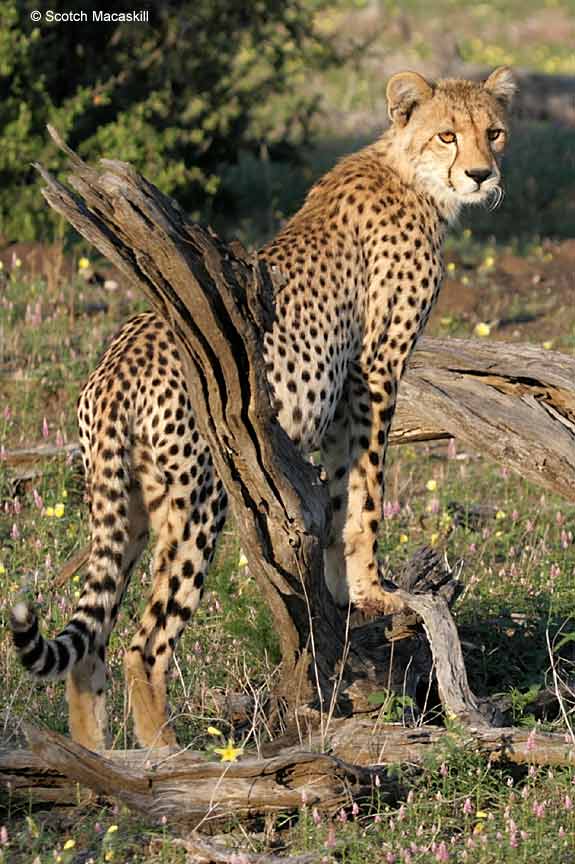
Photo Details:Young cheetah (Acinonyx jubatus) uses tree stump for additional elevation as it scans the surrounding terrain, Mashatu Game Reserve, Tuli Block, Botswana.
Camera: Canon EOS 400D; Lens: Canon 100-400 IS Zoom; Focal Length: 170mm; Shutter speed: 1/500; Aperture: f7.1; ISO: 400.
|
| |
| Back to top of page
|
|
Previous Entries
By Month
By Category
My Original Blog
2005 Entries
2004 Entries
2003 Entries
Who Am I?
Brief Bio
|
| Back to Wildlife Blog Home Page

Home /
Blog /
About /
Contact
Contact Details: Scotch Macaskill, Dirt Road Traders, Currys Post Road, Howick, KwaZulu-Natal,
South Africa. Tel: +27 (0)82 578 2329. Privacy: Your privacy is guaranteed.
See our Privacy Policy for more. This site accepts advertising and other forms of compensation - see
Disclosure and Advertising for details.
Site updated: 2019. Copyright © 2002 - 2019 Scotch Macaskill
|